
How to Get MCS Certified as a Solar Installer

MCS (Microgeneration Certification Scheme) certification is the gateway to residential solar work in the UK. Without it, your customers cannot access the Smart Export Guarantee or most grant funding – making you commercially unviable for the majority of domestic solar jobs.
This guide covers exactly what MCS certification involves, how to get it, how long it takes, and what it costs.
What is MCS?
MCS (Microgeneration Certification Scheme) is a quality assurance standard for small-scale renewable energy installations in the UK. It certifies both the products used and the businesses installing them.
For a solar installation business, MCS certification means:
- Your company has been assessed and meets defined quality standards
- Your installations are documented in the MCS database
- Your customers can access the Smart Export Guarantee (SEG)
- Your customers can access various grant and subsidy schemes
- You can display the MCS Certified logo – a recognised trust mark
MCS is administered by the Department for Energy Security and Net Zero and overseen by mcscertified.com.
Who Certifies You?
You don’t apply to MCS directly. You apply through an MCS certification body – an approved organisation that assesses your business against MCS standards and grants certification on MCS’s behalf.
The main certification bodies for solar PV in the UK:
| Certification Body | Notes |
|---|---|
| NICEIC | Largest electrical certification body in the UK |
| NAPIT | Strong in electrical and renewables |
| Stroma Certification | Specialises in energy and renewables |
| BESCA | Mechanical and electrical services |
| Certsure (part of NICEIC) | Linked to NICEIC |
Most solar businesses choose either NICEIC or NAPIT – both are well established, widely recognised, and have good support infrastructure.
What MCS Certification Requires
MCS assesses your business across several areas:
Technical Competence
- Relevant electrical qualifications (18th Edition, NVQ Level 3 or equivalent)
- Solar-specific training (City & Guilds 2399 or MCS-recognised equivalent)
- Battery storage qualification (C&G 2919) if you’re offering battery systems
- Working at height competence
Quality Management System
MCS requires you to have documented procedures covering: – Site assessment and survey process – System design process – Installation process – Commissioning and testing process – Customer handover process – Complaint handling
This doesn’t need to be complex – a set of clear written procedures and templates is sufficient for initial certification.
Insurance
- Public liability: minimum £2m (£5m recommended)
- Professional indemnity insurance
- Employers liability if you have employees
Business Requirements
- Trading for a minimum period (varies by certification body)
- Companies House registration
- Financial standing checks
The MCS Certification Process Step by Step
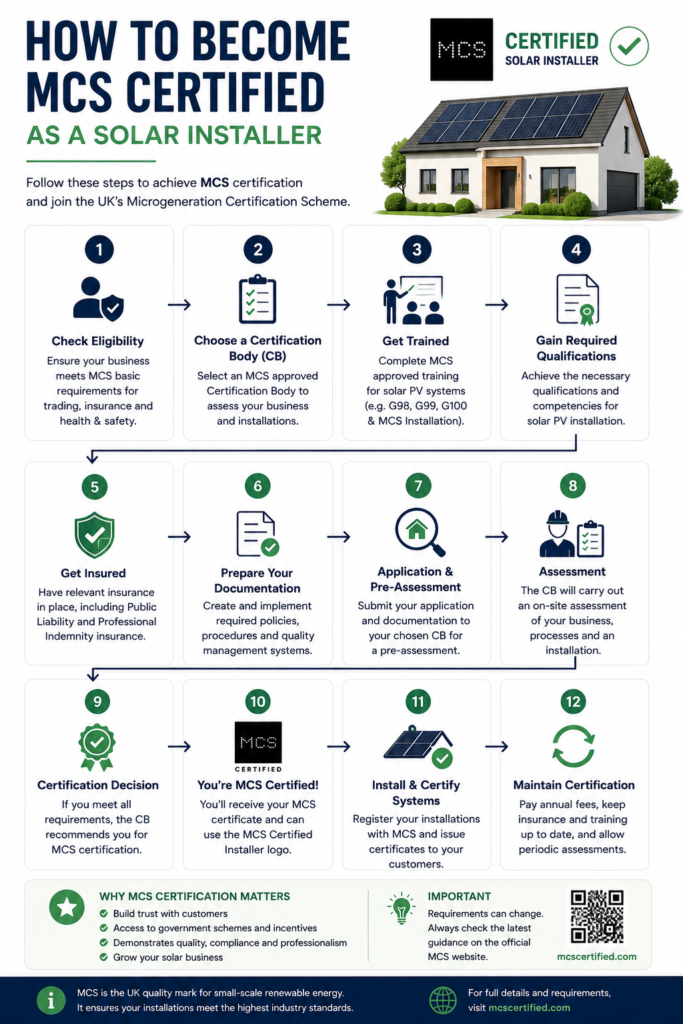
Step 1 – Choose a certification body Contact NICEIC, NAPIT or another body for a pre-application discussion. They’ll tell you exactly what you need to have in place before applying.
Step 2 – Prepare your quality management system Write your procedures. MCS provides templates and guidance. Your certification body will give you their specific requirements.
Step 3 – Submit your application Complete the application form, submit your qualifications, insurance certificates, and quality management documentation.
Step 4 – Desktop assessment Your certification body reviews your documentation. They’ll come back with any questions or gaps to address.
Step 5 – Site inspection A technical assessor visits one of your installations (or a mock installation) to verify your practical competence against the MCS standard.
Step 6 – Certification granted Once all requirements are met, certification is granted. You receive your MCS Certified number and can register installations on the MCS database.
Step 7 – Annual surveillance MCS certification requires annual reassessment, including ongoing site inspections. This maintains the standard and your listing.
Costs and Timescales
| Item | Typical cost |
|---|---|
| Certification body application fee | £500-£1,200 (varies by body) |
| Annual certification fee | £400-£900/year |
| Solar PV training (C&G 2399) | £500-£900 |
| Battery training (C&G 2919) if required | £400-£700 |
| Quality management system preparation | £0 (DIY) to £500 (consultant) |
| Total first year | £1,400-£3,200 |
Timescale: Allow 8-16 weeks from initial application to certification granted. The variables are how quickly you can prepare your QMS documentation and how quickly your certification body processes applications.
What Happens After Certification
Once certified:
- Register every installation in the MCS installation database at mcscertified.com. This is a legal requirement for customer SEG eligibility
- Issue MCS installation certificates to every customer
- Maintain your quality management system – keep records of every installation for surveillance audits
- Renew annually – pay your annual fee and complete surveillance requirements
MCS records are public – customers can verify your certification status at any time on the MCS website. This transparency builds trust.
Frequently Asked Questions
Is MCS certification legally required to install solar panels? No – you can legally install solar panels without MCS. But customers cannot access the Smart Export Guarantee without an MCS-certified installation, which makes uncertified installers commercially unviable for most residential work. See Ofgem’s SEG guidance for details.
How much does MCS certification cost per year? Annual fees with a certification body typically run £400-900, plus any ongoing surveillance costs. Some certification bodies charge per-installation fees on top of the annual fee.
Can a sole trader get MCS certified? Yes. MCS certification is available to sole traders, partnerships and limited companies. The requirements are the same regardless of business structure.
What is the difference between MCS installer certification and MCS product certification? Installer certification certifies your business to install. Product certification certifies that specific solar panels, inverters or batteries meet MCS quality standards. You need installer certification; the products you install should also be MCS-certified products from the MCS product database.
Can I lose my MCS certification? Yes. Persistent non-compliance with MCS standards, failure to register installations, or failing a surveillance audit can result in suspension or removal of certification. Take the quality management requirements seriously.
Professional quotes are part of a quality solar installation business. CoreQuote lets you build detailed, itemised solar quotes from your phone in minutes. Download free on Android — get CoreQuote free.
Related reading:
- How to Start a Solar Installation Business in the UK (2026 Guide)
- What Qualifications Do You Need to Be a Solar Installer in the UK?
- How to Price a Solar Panel Installation (2026 UK Guide)
- How to Market a Solar Installation Business in the UK
- How to Quote for Solar Installation Work
- What Permits Do You Need to Install Solar Panels in the UK?
- How to Start a Solar Business With No Money in the UK
- How to Start a Solar Business With No Experience in the USA
- How Much Does a Solar Installer Charge Per Watt in the USA?
To become MCS certified, you need to: (1) hold relevant electrical or plumbing qualifications and have completed a recognised solar PV installation training course; (2) join an MCS-licensed certification body (such as NAPIT, NICEIC, or RECC); (3) undergo an assessment of your installation work and quality management processes; (4) pay the certification fees and annual renewal. The full process typically takes 3–6 months and costs £500–£1,500 depending on the certification body.
MCS certification is not legally required to install solar panels, but it is effectively essential in practice. Customers need MCS-certified installations to access the Smart Export Guarantee (SEG), which pays them for excess energy exported to the grid. Without MCS, customers lose this financial benefit, which makes non-MCS installations very difficult to sell. Most homeowners and all reputable solar installers therefore treat MCS certification as a baseline requirement.
Initial MCS certification costs typically range from £500 to £1,500 in assessment and registration fees, depending on the certification body. Annual renewal fees add £200–£500 per year. Some certification bodies charge differently depending on the size of the business and the number of categories being certified. The time investment in preparing documentation and undergoing assessment is a significant additional cost, particularly for sole traders.