
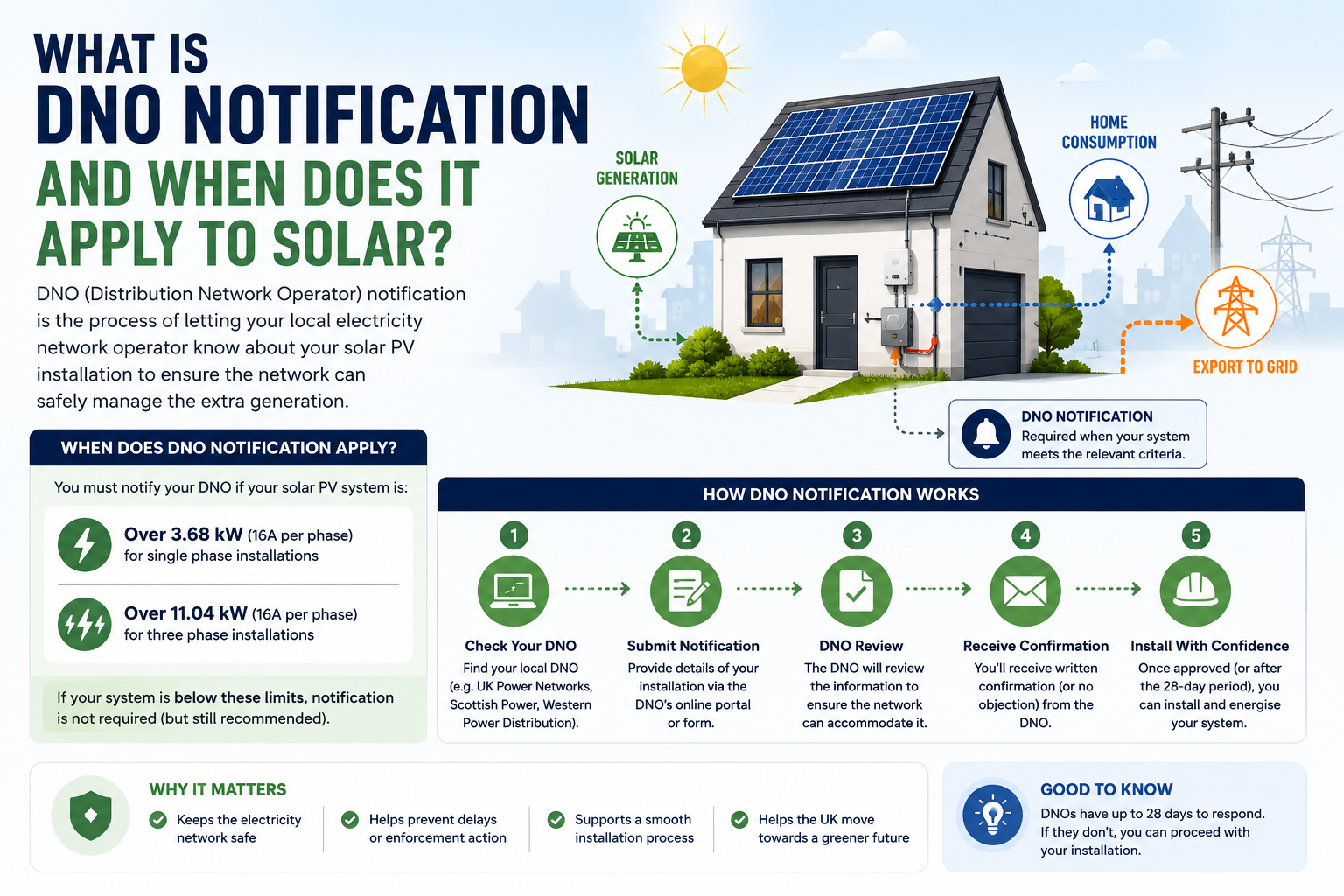
What is DNO Notification and When Does It Apply to Solar?

DNO notification is one of the most commonly misunderstood aspects of solar installation – and getting it wrong can leave your customer’s system non-compliant, their SEG application rejected, or worse, cause grid stability issues.
This guide explains what DNO notification is, when it applies, and what solar installers need to do.
What is a DNO?
A DNO (Distribution Network Operator) is the company responsible for the electricity distribution network in your area – the cables and infrastructure that get electricity from the national transmission grid to homes and businesses.
There are six main DNOs in Great Britain:
| DNO | Region |
|---|---|
| UK Power Networks | South East, East of England, London |
| Western Power Distribution (now National Grid ED) | South West, Wales, Midlands |
| Northern Powergrid | Yorkshire, North East |
| Electricity North West | North West England |
| SP Energy Networks | Scotland, South of Scotland, Merseyside |
| Scottish and Southern Electricity Networks | North of Scotland, South Central England |
When installing solar PV, you’re connecting a generation source to the local distribution network. This affects how the network operates – which is why DNOs need to know about it.
G98 vs G99: The Two Notification Routes
Solar PV connections to the grid fall under two engineering standards:
G98 – Notification (not approval)
Applies to: Single-phase installations up to 3.68kW, or three-phase up to 11.04kW
For most residential solar installations (typically 3.5-5kWp), G98 applies. The process is:
- Complete the installation
- Submit a G98 notification to the DNO within 28 days of commissioning
- The DNO registers the connection – no approval is needed upfront
G98 notifications are submitted online via each DNO’s portal. The installer completes the form; it’s a notification, not an application for permission.
G99 – Application (prior approval required)
Applies to: Single-phase installations above 3.68kW, or any three-phase installation above 11.04kW, or any installation where the DNO determines a technical assessment is needed
For larger domestic systems (typically 4kWp+ on a single-phase connection) or commercial installations, G99 may apply. The process is:
- Submit a G99 application to the DNO before installation
- Wait for DNO technical assessment – can take 4-12 weeks
- DNO issues connection approval (with or without conditions)
- Carry out installation per approved design
- Submit commissioning notification
G99 applications can cause significant programme delays. On larger residential or commercial projects, submit the G99 application during the sales process – before the customer has committed to a date.
How to Determine Which Applies

The key question: what is the total export capacity of the installation?
- Single-phase connection + total inverter capacity ≤ 3.68kW G98
- Single-phase connection + total inverter capacity > 3.68kW G99
- Three-phase connection + total inverter capacity ≤ 11.04kW G98
- Three-phase connection + total inverter capacity > 11.04kW G99
Most UK homes have a single-phase connection. A 3.68kW inverter is approximately 10 × 370W panels. Many systems are sized just below this threshold to stay in G98 territory.
Important: The threshold applies to the inverter export capacity, not the panel capacity. A 4kWp panel array with a 3.68kW inverter export limit falls under G98.
How to Submit a DNO Notification
Each DNO has its own online portal for G98 notifications:
- UK Power Networks: ukpowernetworks.co.uk
- National Grid ED: connectednetworks.co.uk
- Northern Powergrid: northernpowergrid.com
You’ll need to provide:
- Installation address and MPAN (meter point administration number)
- Inverter make, model and export capacity
- Installation date and commissioning date
- Your MCS installation certificate number
- Your company details
Keep a copy of every G98/G99 notification and confirmation. You’ll need these for MCS records, customer documentation, and any future grid queries.
Common Mistakes Installers Make
1. Not submitting at all Some installers skip notification, assuming small domestic systems don’t need it. G98 notification is a legal requirement under Engineering Recommendation G98. Non-notified installations can affect the customer’s SEG eligibility and insurance.
2. Submitting G98 when G99 was required If you connect a system above the G98 threshold without prior G99 approval, the DNO can require disconnection. Check inverter export capacity carefully.
3. Missing the 28-day window G98 notifications must be submitted within 28 days of commissioning. Set a reminder on every job.
4. Wrong MPAN The MPAN (meter point administration number) must be correct – it’s how the DNO links the notification to the specific property. Find it on the customer’s electricity bill or smart meter.
Frequently Asked Questions
Do I need DNO approval before installing solar? For G98 installations (≤3.68kW single phase), no prior approval is needed – you notify within 28 days of commissioning. For G99 installations, prior DNO approval is required before installation begins.
How long does a G99 application take? Typically 4-12 weeks, though complex applications can take longer. DNOs have statutory timescales they should meet but don’t always. Submit G99 applications early – during the sales process if possible.
Is DNO notification the same as MCS registration? No – they’re separate requirements. MCS registration is for the microgeneration certification scheme (customer’s SEG access). DNO notification is a grid connection requirement under engineering standards. Both are required for a compliant residential solar installation.
What happens if I don’t notify the DNO? The installation is non-compliant. The DNO can require disconnection. The customer’s SEG application may be refused. Your MCS certification can be at risk if audited. Always notify.
Who submits the DNO notification – the installer or the customer? The installer. It’s the installer’s responsibility to submit G98/G99 notifications. This is part of the commissioning and handover process for every solar installation.
Keep compliance documentation with every job
CoreQuote helps solar installers manage every job from quote to completion — keeping track of certification and compliance documentation.
Download CoreQuote FreeSee everything CoreQuote does on the download page.
Related reading:
- The Green Trades Boom: EV Charging, Solar and Heat Pumps Explained
- How to Start a Solar Installation Business in the UK (2026 Guide)
- What Qualifications Do You Need to Be a Solar Installer in the UK?
- How to Get MCS Certified as a Solar Installer
G98 applies to smaller domestic solar PV systems (typically up to 3.68kW per phase) and requires notification to the Distribution Network Operator (DNO) within 28 days of commissioning — you notify after the installation. G99 applies to larger or more complex systems and requires pre-approval from the DNO before installation begins. Most domestic solar installations fall under G98; commercial or larger residential systems typically require G99 pre-approval.
DNO pre-approval (G99 application) is required when the system output exceeds the G98 threshold for the number of phases, when the installation is at commercial premises, or when the system includes battery storage above certain thresholds. The DNO may take up to 45 working days to assess a G99 application, which should be factored into project timelines when quoting.
The responsibility for G98 notification and G99 application rests with the installing engineer or company, not the customer. This is why solar installers need to understand the notification requirements for each project type as part of their quoting and project planning process. Failing to notify the DNO correctly can affect the customer’s ability to access the Smart Export Guarantee (SEG).